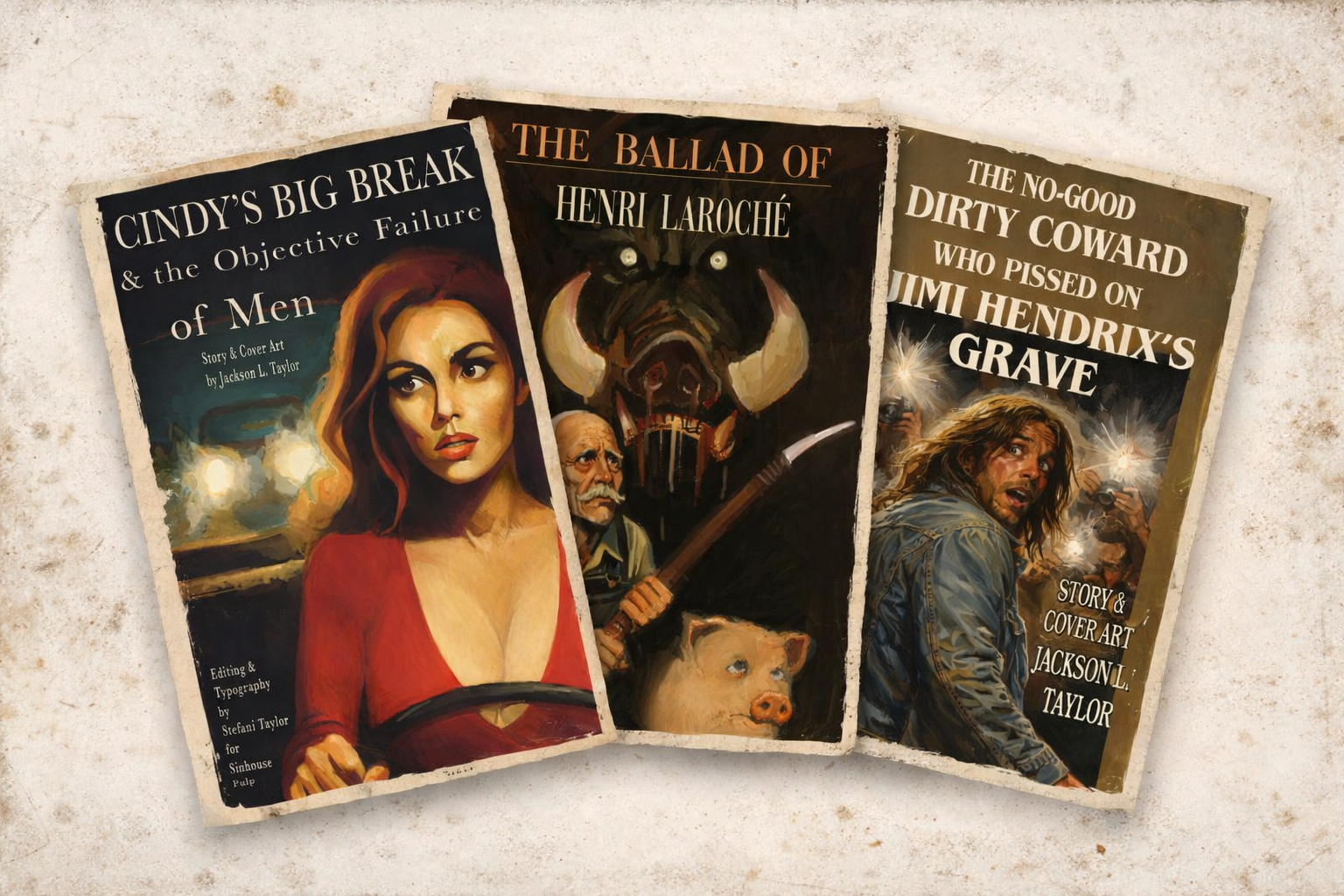

Cindy’s Big Break & The objective failure of men
Sinhouse Audio Story

PART 1 — THE TAPE
“Here’s how I heard it—and this is straight from Luther King, Sonny Ray Redding’s drummer.
The one from the Tear Me Down LP—not that twat he’s using now.
And listen—Luther knows his shit when it comes to myths, legends, all that weird stuff.
You know that Robert Johnson ‘sold his soul’ ghost-story bullshit?
Dude, that really happened.
And it wasn’t the Devil.
It was aliens—just like in the Book of Enoch.
All that crazy shit is one hundred percent true—the aliens, the giants, all of it.
There’s a bunch of books from the Bible they hid.
Luther knows all that mess.
His ex-wife was a legit Egyptian and knew everything about pyramids and curses.
She was a spooky bitch.
She was a sweetheart, don’t get me wrong.
There was just something off about her.
It’s a shame what happened to them.
Anyway, we were opening for Sonny.
Luther got so high he forgot what time our set started.
Total mess.
But that’s when he told me Bubellé Reinholdt really tortured—really tortured and murdered—the guy who made Sydney’s LaRoche.
Yeah, the million-dollar fiddle.
You know he played that museum piece on Buck Williams’ new record?
A thousand-year-old work of art on a bumpkin hillbilly album.
Well, the man who made that fiddle was tortured to death by Bubellé Reinholdt.
That’s where Reinholdt got his guitar—the masterpiece.
The luthier—Henri LaRoche—came from a family that had crafted ‘magic’ instruments for over a thousand years.
And you know how folks say they ‘saved the best for last’?
That’s exactly how it went.
It’s a big corporation now.
But before the war, it was a tiny mom-and-pop shop.
Back then, they had the caste system—you didn’t pick your path.
You became whatever your father was.
Twenty generations of instrument makers—and Henri was the last and the most gifted.
After his wife died, he became a recluse.
For decades.
No one had seen hide nor hair of him in fifty years.
Meanwhile, Bubellé and his fiddle player were tearing up Paris.
They’d signed their first deal.
They were just about to cut their first record when the rumor started spreading—”
PART 2 — CINDY BEGINS
Cindy stopped the tape.
She shuffled through the original police report Inspector Lucien Morel had been kind enough to send her.
Getting the file was a stroke of luck—and annoyingly, Gypsy Jake’s idea.
For a male chauvinist beatnik burnout who needed to retire, he still coughed up a good idea now and then.
She would never have thought to request a Paris police report.
She liked to imagine she always thought of everything—but honesty, when it rarely surfaced, told her otherwise.
But this was the big league: her first mainstream publication.
A magazine she’d read since childhood.
A magazine her mother read.
She needed to make a strong showing.
She was going to be a real vest-wearing reporter.
If she didn’t daydream so much about the awards she’d win, she might’ve finished the story already.
Her imagination set her apart—and stalled her out.
It was late summer.
The days were shrinking.
Fall—and the long winter—loomed close.
Staying consistent was hard when the beach block parties kept calling.
Back home, time was simple.
Her school had 118 kids, grades one through twelve.
Not much competed for attention.
A few awkward backseat “adventures,” more fumbling than thrilling.
But Berkeley had changed her.
She’d blossomed physically and mentally.
Her spiritual and psychological growth felt profound—so profound she feared no future husband would be on her level.
Back to work, Cindy, she scolded herself.
But the files bored her.
They were so dry that her mind immediately slipped back to her real problems.
One of them was Jeffrey, the SinHouse intern who’d translated the report.
He wasn’t being generous—he was leveraging his bilingual advantage to corner her into a date.
She only agreed under pressure.
That didn’t make her a whore.
Of course, she wasn’t going to sleep with him.
Even if he hoped.
Which men always did.
She admired her eyeshadow in the window.
Another problem: she hadn’t called her mother.
But calling her mother wasn’t a call—it was an ordeal.
A full hour of emotional labor.
She checked the clock.
Not late.
Not early.
She should be at the Fillmore covering new bands.
That’s what real music journalists did.
Don’t write ghost stories about a luthier who died a century ago.
Except… she had heard of LaRoche.
Everyone had.
She’d visited their New York shop plenty of times to fix her brother’s violins.
Her father always said the instruments were overpriced junk—but the five-year repair guarantee was useful.
Her brother was a klutz.
Then it hit her:
Was it the same LaRoche?
PART 3 — JEFFREY
Cindy had inherited her grandmother’s True Detective magazines.
Cindy devoured them as a girl.
She had even pitched a serial-killer article to SinHouse.
They passed—and gave her this instead.
Her first story.
Her breakout story.
A story about a murdered guitar maker she’d never heard of.
She pulled out her personal day-player—the boutique recorder her father had given her when she got hired.
SinHouse made her use the clunky machine for interviews.
But this one held her private thoughts.
She recorded a note to look into the LaRoche company further.
She traced the Nagra’s smooth reels.
It looked more like a sculpture than a device.
Nagra was a strange name.
She couldn’t think of a better one if she tried all day.
She wondered what Jeffrey was doing.
Probably trying to score Spanish fly.
She dismissed it—he didn’t seem like that type.
Clean shirts.
Pressed collars.
Respectable enough.
Where had he learned French?
He didn’t look French.
More Scandinavian.
A surfer—blond hair, bronzed skin.
Handsome enough to get dates without coercion.
He shouldn’t have to corner girls.
She checked her watch.
Later now.
The band had probably started.
She wanted the whole press-pass experience—flashing her badge, sliding ahead of the line, sitting at her own table.
Her notebook was blank except for the title Gypsy Jake suggested:
THE BALLAD…
The internal negotiations began.
Stay and work?
Or go to the Fillmore and live the life she imagined?
1933 was a long time ago.
Black-and-white films.
Fred Astaire and Ginger Rogers.
Ginger is doing everything backward—in heels.
Women always worked three times harder.
Something from the tape replayed:
“Back then, people had to do what their parents did. It wasn’t like today.”
He wasn’t wrong.
Her irritation with Gypsy Jake softened.
He had been helpful—and polite—even if he’d stared when she bent to pick something up.
Sometimes it thrilled her to excite men.
And Jeffrey…
Would he be at the Fillmore?
Probably.
Maybe with Belinda—the bubbly, skirt-too-short fake who laughed with anyone breathing.
Cindy’s stomach tightened with jealousy.
Jeffrey was already picking out sons’ names.
She could feel it.
He’d want boys.
She wasn’t about to be tied down by some above-average, handsome, French-speaking, Marine-looking surfer.
Not yet.
Not until she was ready.
She pictured him shirtless in the jungle—Green Beret knife between his teeth, ammo belts across his chest.
Her thighs shifted involuntarily.
She smiled.
Her breasts had finally come in that spring.
A late bloomer, but blooming.
Her smile hardened.
Belinda.
The thought of those two together made her furious.
She packed up—then paused.
Looked at the empty page.
Closed the notebook.
PART 4 — TURNING
After all that, this was the real story—
The story is happening now.
Why was SinHouse publishing ghost pieces when she was right here—young, brilliant, ready?
Her father always said:
“You have to fight for what you want. No one will give it to you.”
He was right.
Except for this assignment.
This assignment was worthless.
She grabbed her keys.
Belinda.
Jeffrey.
The Fillmore line.
This was an emergency.
If she left now, she could make the show—maybe grab a drink with Jeffrey.
Maybe two.
She could bang out a quick band review to tack onto the ghost story.
Surely then they’d recognize her talent.
Not that slut Belinda.
She hit play.
PART 5 — THE TAPE RESUMES
“Well, it was right after they cut their first record that LaRoche’s best friend’s neighbor notified the police.
Oh man, it wasn’t good.
Think about what those Manson creeps did to that pretty movie star.
Well… this was worse.
A literal black-mass human sacrifice.
Everyone knew right away it was Bubellé Reinholdt—and that’s where he got the guitar.
I guess they questioned him.
He and his fiddle player hopped a freight and stowed away to America.
And the rest is history.
The record blew up.
Reinholdt could play, man.
But he was one crazy, evil, devil-worshiping son of a bitch—just like Luther said.
Luther knew all that shit.
He was talking about the Book of Enoch before I’d ever even read The Hobbit.
I like that dragon—Smaug—badass name.
I’m telling you, man—it’s aliens.
Luther said they’ve always been here.
And that maybe we’re aliens too.
Which makes perfect sense because I’ve always felt like I wasn’t from this earth—like I got shipwrecked here.
Have you ever felt like that?
Makes perfect sense to me.
Luther said they mixed their DNA with ours.
He was all about that shit.
Last time I was with them—his wife, the Egyptian I told you about—she pulled out this ancient book.
Looked ten thousand years old.
It was called The Book of the Dead.
I skimmed it.
But it was spooky.
I don’t like spooky.
I like fantasy stories.
Then they pulled out the Ouija board.
I finished my joint and left.
Man… it really is a shame what happened.”
PART 6 — DECISION
Cindy turned off the tape.
She shuffled the police reports.
She checked her watch—now it was truly late.
If she wanted to leave, make the show, have a drink, and get closer to Jeffrey, she had to go now.
Tomorrow could handle the ghost story.
Jake had said, “Call anytime if you get behind.”
Good enough.
An axe behind the glass.
She rechecked her watch.
This was an emergency.
She pictured the Fillmore line.
The press pass.
The usher waving her in.
Belinda is nowhere in sight.
Jeffrey smiling.
Obviously, the right thing was to go.
PART 7 — FINALLY MADE IT
Cindy stepped into the cool night.
Summer was gone.
She slid into her baby-blue Karmann Ghia.
She put on Sonny Ray Redding’s Greatest Hits.
Her father’s favorite.
The soundtrack of every homesick stretch of her life.
She reapplied the lipstick she’d bought the moment Jeffrey asked if she liked Italian food—said he knew a great place she “should try.”
She smiled—didn’t even check the mirror.
She already knew she looked good.
She giggled and lifted her bosom until she felt the night air on her nipples.
Started the car.
Took a breath.
She was finally here.
She had finally made it.
Her stomach fluttered at the thought of Jeffrey’s bronze skin and shimmering blond hair.
She turned the key.
The engine coughed and died.
Her heart dropped.
Then she remembered the alternator—forgotten after all the drama of Jeffrey begging her for a date.
She’d parked at the top of the hill like Gypsy Jake told her.
Neutral?
Brake off?
Clutch in?
Or brake on, first gear, then clutch?
Time was ticking.
The line is shrinking.
Her press-pass fantasy drifting.
She pressed the clutch.
Stepped off the brake.
Rolled downhill.
Eased up—
The engine sputtered to life.
She straightened the mirror.
Imagined a yellow solitaire on her left ring finger—traditional but progressive.
And ignored the empty fuel light flickering