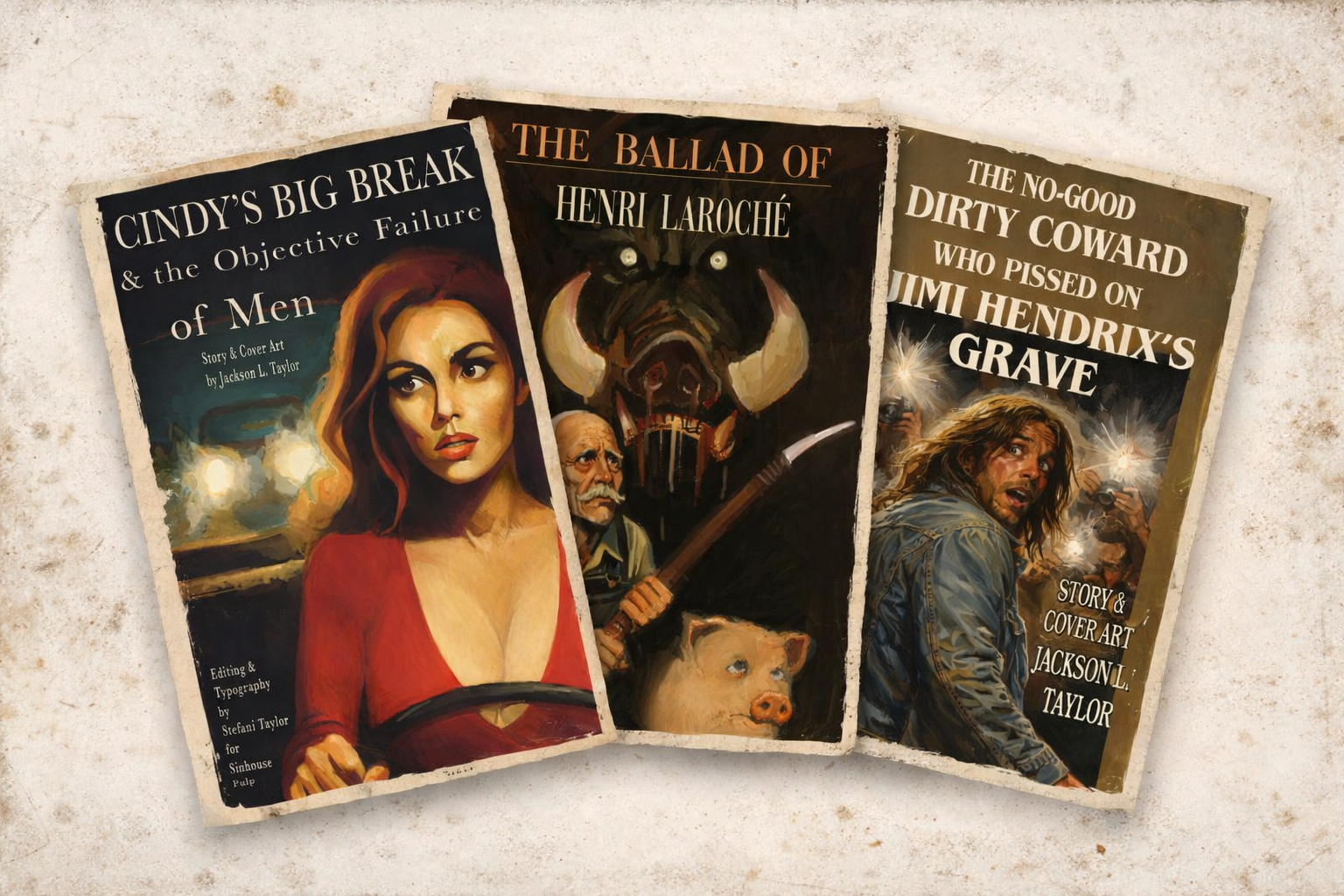

THE BALLAD OF HENRI LAROCHE
Sinhouse Audio Story
Henri LaRoche woke on the morning of his hundredth birthday with a pep in his step so unexpected it startled him. That light feeling had been absent so long he had forgotten it existed. He could feel the buzz in his bones. He had slept through the night, waking famished for the first time in decades.
The tune the young man had played the night before still swirled through his mind, quick and light, teasing a smile from him every few moments. Without thinking, he slipped into a quick jig as he sliced tomatoes and smeared brie across toasted bread.
Why not, he thought.
He stretched, reached for the dusty jug of wine, pulled the cork with his teeth, poured a thimble into a glass, then filled it to the top. Wine splashed over the toast and brie, making Henri dizzy with delight.
Perfect, he thought.
He danced a side step toward the icebox, pulled out a slab of bacon, and set it on the butcher block. Rising on his toes, he looked out the window. Loretta lay in a patch of sun warming her pink skin, swatting flies with her tail—a queen in her realm.
He felt a pang of guilt as he fried bacon with her so near the kitchen door. He eyeballed the distance. She was too close. But the rare energy running through him brushed the guilt aside. This kind of morning called for something more substantial than toast, and he had already decided on another glass of wine.
A sudden, overwhelming compulsion struck him: he wanted to play his guitar.
He had not played in twenty years—not since his wife lost a long, brutal war with the tumors. He had always imagined retirement filled with music, pouring every breath into the player he dreamed he could be.
The thought of the tumors made Henri wince. He shook it off with another glass of wine from the dusty bottle. He filled the small glass, poured it into a larger cup, filled it, and drank it. A laugh burst out of him—loud, unplanned, exhilarating. The surprise of his own laughter made him laugh harder.
And that was the beginning of Henri LaRoche’s hundredth birthday: a belly full of brie, a mouth full of wine, a nose full of bacon, and a head full of music, and memories of a life lived well.
The music inside him grew louder. He felt the urge to work out the pieces the young man had played. His fingers searched the air for the correct notes while he thought back through his memories, wondering where he might have packed away a guitar to play. His masterpiece had sat by the fireplace for thirty years while he perfected it—tuned, refined, adjusted—but never played for enjoyment. Now he found himself drunk and frantic, hunting for an instrument he knew wasn’t there. He had given it away. He remembered the beautiful young man with the cruel eyes, the presence that filled the room. Henri must have been swept into madness when he handed him the finest instrument he had ever built. The boy’s playing had been emotional and effortless, coaxing impossible beauty even from the battered box he carried.
Henri had known immediately: he was standing in the presence of greatness.
All his life, he had wanted to be a great player, yet his time had belonged to the workbench—dawn to dusk, late into the night—building instruments for others to enjoy. He had forgotten how deeply he loved to play until he had watched the boy do what God had made him to do.
That was why Henri had built the masterpiece. Crafted it and perfected it.
He knew it was the best instrument he had ever made. That is why he never played the guitar. He wasn’t the one his masterpiece was built to play.
After the tumors, he gave up building altogether. Only Loretta, the cold, and his dwindling, dusty bottles of wine were capable of coaxing him off the couch or outside his kitchen. His instruments, crafted by him, became even more sought after. For ten years, Henri had been offered fortunes to make just one more guitar or violin. Finally, tired of the begging, he gathered the dozen instruments he had been working on at the time of his wife’s death and announced he would auction them off—and that would be the end.
Wealthy collectors and desperate musicians came from all over Europe, Asia, and America to bid on an unfinished LaRoche. His family had been designing and handcrafting fine stringed instruments for three centuries. Henri was the last now that his sons and his grandchildren were gone. To be spared the bother, he publicly donated all the proceeds of the sale to his three remaining apprentices, who would act as three licensed repair shops for the hundreds of LaRoche instruments in circulation—one in Paris, one in London, and one in New York City. After the auction and announcements, people forgot about the honest Henri LaRoche in favor of the apprentice who was the go-to for finding a LaRoche or getting an instrument close, if not quite to the standard set by generations of trial and error.
Henri had spent every rare free moment of his time for over three decades crafting the guitar he planned to devote his old age to. Nothing had gone as he imagined. His family was gone, and with them the love of music.
At this moment, Henri regretted giving the masterpiece away—for what is a masterpiece without a master—yet the moment he heard the boy play, he knew it had been destiny.
When the beautiful boy played the masterpiece, he finally understood his true purpose: to be the catalyst. His instruments were the vessels through which great players become legends. He knew soon his efforts would be too valuable for real musicians—destined for museums and wealthy vaults and not passed between families around a fire under the moon. That’s why he gave the prodigy his masterpiece. But the boy—the beautiful young man with the cruel eyes—would never be owned by anyone. He would play the guitar better than anyone. He would make recordings with it. People around the world would hear his finest work played as finely as it could be played forever.
Henri searched the house again, making a mess. Surely one guitar remained. What a predicament to find himself in.
He needed to play. Henri hobbled across the yard and into the old workshop where generations of his family had spent their lives in the same manner he had. He would be the last. He was the last. Three hundred years of sawdust and varnish still permeated everything. He had not been up the narrow stairs in at least a decade. His joints protested, but his compulsion won the battle over prudence, and up he went. He felt every creeping step in his creaking bones.
At the top, his father—and his father before him, and his father before him—worktable waited exactly as it had been set for centuries. Chisels arranged with reverence, planes resting together like old friends, sketches and blueprints pressed flat beneath glass plates.
He opened the trunk his father had kept beside the table—the place where small heirlooms, old sketches, and forgotten tools slept waiting for inspiration to make use of them. There his quarry lay. Covered in cobwebs that even the spiders had long since abandoned. The shop was brutally cold with no fire. Too cold for spiders anyway. Henri could see by the little black droppings and gnaw marks that the mice had made a home of the shop. The first guitar young Henri had ever built lay in the trunk. Still blackened with soot. A crude thing by LaRoche’s standards—unsophisticated, ugly, the kind of failure that might shame a five-generation artisan. Henri had tried to burn it without even stringing it, but his father wouldn’t allow it. He took the guitar, tuned it, played it, and for the first time, Henri heard something unexpected: warmth, sweetness, something undeniably alive. His woodwork was crude, but it sounded like a LaRoche. Even Henri’s self perceived failures had the potential for greatness.
Henri lifted the abomination out of the trunk and examined it closely. The soot and mice gnawing were superficial, but the strings, God bless them, were still intact. Wincing at the stiffness of his old fingers, he tuned it, praying the old rusty strings wouldn’t break, and they didn’t.
When he played the first chord, something inside him that had been building all morning cracked wide open.
The sound was a bit dull but audible. Beneath the rusty strings, soot and gnaw marks lived the unmistakable LaRoche signature: that warm pluck, that sweet attack that made players close their eyes and breathe differently and play better. His hands, stiff with age, still remembered. They moved better than they had in his youth, he thought—his playing was constant and precise, filled with emotion. His confidence surged as a great, rolling laugh burst out of him. He cradled the abomination like a long-lost friend, carried it down the stairs with care, crossed the little yard, and stepped back into the kitchen. His wine waited. His chair waited. His fire waited. It was time, he thought. Time to play.
Just then, Loretta squealed at the kitchen door. She was polite at first—a couple of small grunts, then a tap on the door with her right hoof. When Henri didn’t come quickly enough, she let out a higher-pitched, insistent squeal. Patience was not an attribute Loretta possessed.
“All right, girl,” he said. His voice was a little too breathless for comfort, and he knew it. “We’ll go.”
A short walk won’t hurt, he thought. Loretta moved with surprising grace for such a round creature, the tip of her snout brushing the soil, reading the forest floor the way Henri read grain in spruce. She lived for this. And in truth, so did he. Loretta, their walks, and the wine were all that truly sustained his interest enough to continue living.
Within an hour, she found three perfect truffles, each time squaring her stance and giving that proud, satisfied grunt that Henri had always found so much joy in. He was exhausted, but she was joyous—and he couldn’t take that from her. Not yet. Whatever had gotten him this morning had gotten into his old girl, too. Zeroing in and marking another buried treasure, she offered up a few fine bulbs which always gave Henri one of the few real joys left in the living world for him. She was a fine, fine pig.
But the shadows lengthened, and the cold doubled down, reaching deep inside his muscles. They were too old to be caught out here after dark and perhaps too old to be out here at all.
He gave the call—a sharp grunt of his own—she bucked once more and looked back with a pleading look. She had caught the scent of another truffle, but immediately trotted to his side because he was, without question, her favorite thing in the world. She even loved him more than the truffles. He loved to watch her walk ahead of him. She loved to watch him lead the way. She trusted him completely.
They had become each other’s reason to wake and try to live.
At the farmhouse door, he hesitated, suddenly ashamed as her snout flared. She smelled the bacon on the kitchen table. He wasn’t sure why that shame clawed at him, but it did. He never wanted her to see him cook or eat pork. Just didn’t seem right.
He unhitched her harness, planning to bring her inside tonight after he cleared the table. It was going to be a cold night, and he knew she’d enjoy the fire on her back listening to him play. He looked through the kitchen door window and checked the top cupboard. One more dusty bottle of wine. He smiled with relief. He was bending to unhook the strap from Loretta’s bit when a blur of black flashed across his peripheral like a racing bull—
And the world exploded.
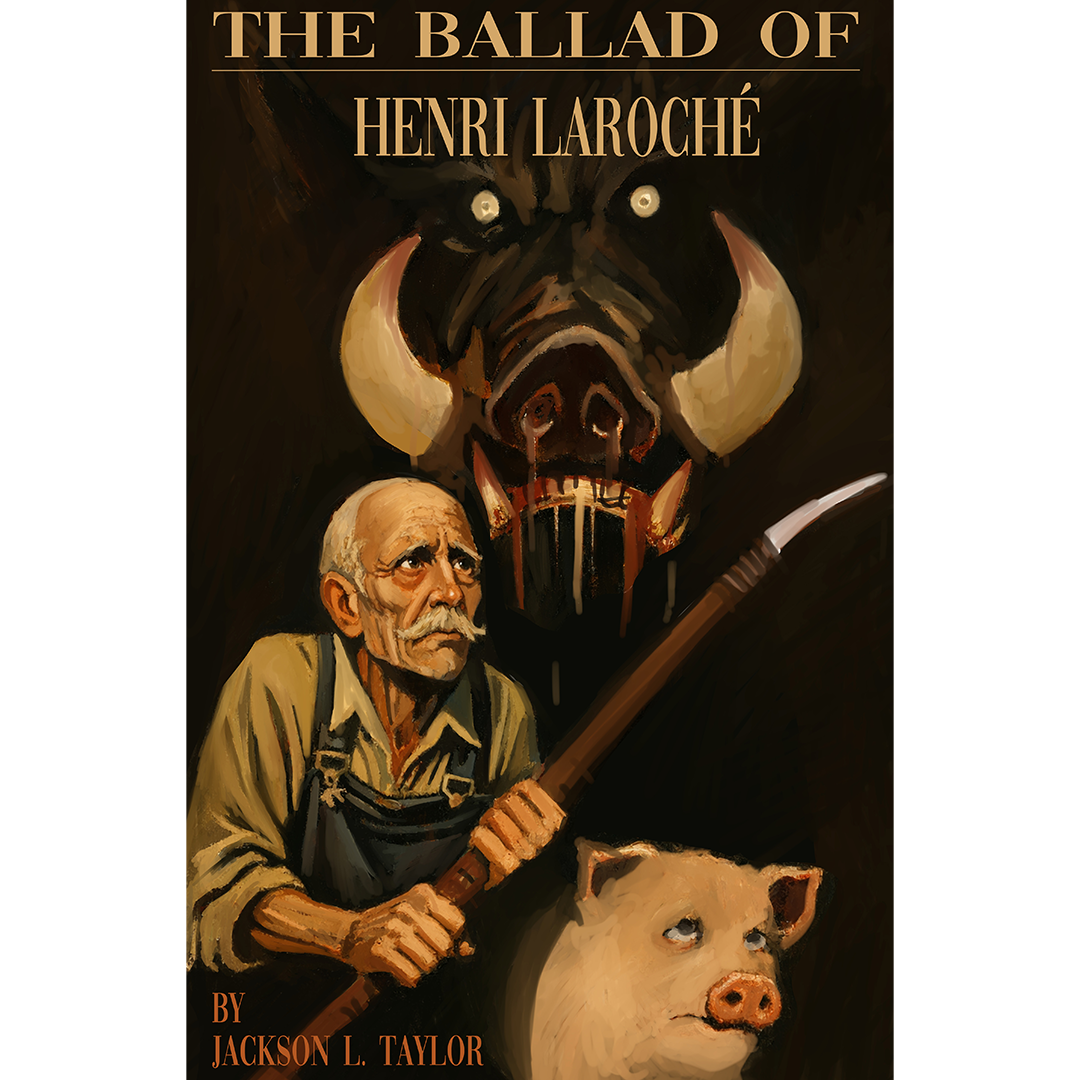
The force pushed him like a locomotive. He felt the world escape as he flew backward, thrown a dozen feet, crashing hard against the ground. Loretta’s screams cut through everything, even his confusion. He blinked through the haze and saw it—the monstrous black boar, tusks tore deep in Loretta’s belly, pinning her sideways against the door of the shop. It lifted her off the ground as it thrashed her like a shark in shallow waters.
Henri tried to rise but collapsed. His mouth had filled with blood. He gagged and tried to catch his breath as his chest burned and his ears rang. His childhood flashed before him—his mother bursting through the kitchen door, his four-year-old body tossed into a snowbank after pulling a boiling pot off the stove down onto him. He would smell the skin bubbling up on his neck and chest. He had wondered whether a man’s life truly flashed before his eyes before death. For a moment, he believed he was dead until the squeals shifted—from his childhood to Loretta—and the present snapped back into focus. The boar drove its tusks in deeper. Loretta’s squeals hit a pitch of an animal being ripped apart.
Rage surged through Henri’s body and reset every cell, giving him one purpose; no fear, no concern, the only one thought personified him in that moment: Kill that fucking boar. He fought to stand. His truffle hoe lay nearby. He grabbed it, using it as a crutch, and lurched forward, but Henri’s frail body was broken. His thigh bent at an unnatural angle. He was walking on the side of his foot, not the bottom. The pain was so severe that it overwhelmed his ability to gauge the situation. One step at a time. Right foot forward. The left foot dragging behind. Again. Again. He lifted the staff over his head, meaning to throw himself, spear-first, into the beast. But he was too old, too light, too broken. The impact would barely pierce the hide.
He’d had only one thing left—the one thing ninety-five years of craftsmanship had perfected:
His hands. His aim. His control.
Gripping the truffle hoe in both hands, moved in a slow circle to the boar’s right side, and searched for the softest place on the neck—that small window of mortal flesh beneath the armor of gristle.
He thrust the tip of the hoe forward.
It punched through the hide, tore a piece of the jugular, and lodged in the voice box. The boar’s squeal collapsed into a wet, ruptured croak—like a busted kick drum.
Blood sprayed in violent arcs, speckling the grass, the walls, and Henri himself. The beast staggered, then turned on him.
The boar reared back like a bull. One tusk caught Henri in the left lung and threw him backward into the chicken coop. Rotting boards shattered around him. Feathers burst into the air.
He called for a hammer—instinct, memory, delirium—and for a moment he saw his son Lony again, a boy with his mother’s eyes, running toward him with a hammer in hand. The illusion vanished as quickly as it came.
Pain fogged the world. Pink, frothy blood bubbled from Henri’s ribs with every breath. Loretta screamed outside.
He pushed himself upright. He saw the cheese knife glinting on the floor and grabbed it, missing the shotgun hanging just above the door.
The yard was a battlefield of trampled grass, blood pooling, and the tall field grass swaying in the fading light. The boar circled—only the top of its hulking back visible. The spear stuck in its throat pumped out arterial spurts that grew shorter and shorter.
Bleeding out, Henri thought. But not fast enough.
He reached Loretta. Kneeling beside her, he saw her insides torn open, glistening in the pale, fading light. He tried to put them back in—stupid, desperate, primal—and she squealed in agony.
He lay over her, shielding her with his body. He knew the boar would charge again.
The sound came first—that broken, locomotive choking from its throat.
Then the grass parted.
The boar struck.
The tusk drove deep into Henri’s back, breaking ribs and collapsing his left lung entirely. He screamed—a slight, cracked sound—and felt himself lifted into the air, impaled.
The world turned upside down. The sky spun. He hung from the boar’s tusk as it shook him violently, trying to dislodge him.
He came loose all at once and flew upward—for a heartbeat, he floated, looking down at the madness below—then crashed face-first into the dirt.
He lifted his head just in time to see the boar coming again.
But as it charged, the truffle hoe lodged in its throat snagged on the coop and ripping the hoe free and severing the jugular entirely.
The boar staggered to a stop over Henri, gasping—sucking air and blood through the ruined hole in its throat, the sound monstrous and pitiful.
For a moment, Henri felt something like sympathy.
Then the beast clamped its jaws onto his back and dragged him across the grass, circling, confused, dying.
Two feet from Loretta, the boar stumbled, collapsed, and went still. Its jaws loosened. Henri rolled free.
He lay still for a moment. And the music from the night before returned—the beautiful young man with the cruel eyes playing by a campfire somewhere far away in Henri’s imagination, every note precise, pure, perfect.
Broken, bloodied, fractured, dying, Henri LaRoche had never wanted anything so much as to be sitting in his chair in front of the fire, sampling his homemade wine, playing his guitar for Loretta. While she harassed the poor flies with her tail who wanted nothing more than to share such a fine moment with such a fine pig. But Loretta had no sympathy or tolerance for flies regardless of what they may want or why.
He rolled toward Loretta, using her body to push himself upright until he was seated against her shoulder. To his astonishment, she was still breathing—faint, shallow, but present.
He whispered to her that he was going to bring her inside, put her by the fire, and play for her. She had earned that. They both had.
He dragged himself inside the house. He moved the table aside. He cleared space in front of the fire. He wasn’t sure how he managed it—but somehow, the universe allowed him that small mercy.
He returned for Loretta. Dragging her felt impossible, but he did it anyway. He placed her on a blanket before the fire, covered her, and watched her breathing grow a little steadier in the warmth.
He opened the dusty bottle of wine—the last one—poured it, and set it aside.
He took up the abomination and sat in his chair.
The pain faded. His hands became steady. He began to play.
And he played better than he ever had. Better than anyone ever had. Maybe even better than the beautiful young man with the cruel eyes.
The final chord rang softly. Henri exhaled, a long red sigh. He smiled—slow, knowing, grateful.
And Henri LaRoche, fully accepting his place in the world and the time he lived in, finally comprehended and embraced the part he had been cast to play on this earth. For the first time, he was precisely where he wanted to be, doing exactly what he wanted to do. He no longer regretted ever falling in love. The good times had been worth the bad. She had been the right woman, and he watched their life together pass before him—all the moments time had stolen—returning now like a blessing.
His mind drifted to his sons. Beautiful boys who had grown into strong, good men—luthiers in their own right. The demand for LaRoche instruments had long exceeded the supply, and his sons’ work had soared in value right alongside his own. Perhaps one day, he thought, their names would surpass his.
Loretta was breathing more strongly. The light in the room had faded to a warm dusk. He was grateful for the foresight of pulling down the jug of wine from the top shelf. He filled his glass and took another long, satisfying pull. It seemed full again when he lowered it. That made him chuckle.
He had always been a lucky man. Things had always worked out just right for Henri LaRoche. And this day—against all odds—had become a perfect one.
For a moment, an image flashed: his frantic hands trying to shove her entrails back into her body—how hot and slippery they had been, how they kept sliding against his palms, how her screams had broken him. Then the memory faded, replaced by the crackle of the fire and the soft sound of Loretta shifting her weight on the floor, settling in.
The room was nearly dark now, but he could still see her in his mind’s eye—her left leg twitching as she dreamed.
It must not have been as bad as I thought, he told himself. He was an older man. Older men misjudge things. Older men overreact. Older men are overwhelmed easily.
It was darker now than Henri could remember it ever being. For a brief, terrifying moment, he thought he was dying until he heard the melody again—the one the beautiful young man with the cruel eyes had played in this very room the night before. It was so clear, so present; it felt as if the boy himself were standing in the room, though surely he was miles away by now.
Henri smiled as the undeniable truth came to him.
He was listening to himself play. And he was playing perfectly.
Then the man who had spent a hundred years doing what his family and God expected of him—a man celebrated and revered for craftsmanship, yet always reacting to life rather than crafting it—closed his eyes and smiled with intent.